Mercury, the smallest planet in our solar system and the nearest to the Sun, is a fascinating realm of extremes. Named after the swift-footed Roman messenger god, it zips around the Sun faster than any other planet, completing one orbit every 88 Earth days. Despite its proximity to our star, Mercury remains one of the least explored terrestrial worlds—only two spacecraft have orbited it, with exciting new data on the horizon from the ongoing BepiColombo mission (a joint ESA/JAXA endeavor set to enter orbit in late 2026).
Here’s a stunning high-resolution view of Mercury’s heavily cratered surface, captured by NASA’s MESSENGER spacecraft—revealing a Moon-like landscape scarred by billions of years of impacts:

Mercury – NASA Science
Key Facts & Physical Characteristics
- Size & Density: Mercury has a diameter of about 4,880 km (3,032 miles)—roughly 38% of Earth’s size and only slightly larger than our Moon. Yet it’s the second-densest planet after Earth, thanks to its massive iron core that makes up about 85% of its radius.
Check out this side-by-side size comparison of Mercury and Earth to see just how tiny it is:

File:Mercury, Earth size comparison.jpg – Wikimedia Commons
- Orbit & Rotation: Mercury follows a highly elliptical orbit, swinging from 47 million km to 70 million km from the Sun. Its unique 3:2 spin-orbit resonance means it rotates three times on its axis for every two orbits around the Sun. One full solar day (sunrise to sunrise) lasts 176 Earth days—twice as long as its year!
This creates bizarre effects: from certain spots, the Sun appears to rise, set briefly, then rise again due to the planet’s speed near perihelion (closest approach).
- Extreme Temperatures: Without a substantial atmosphere to trap heat, daytime temperatures soar to 430°C (800°F)—hot enough to melt lead—while nights plummet to -180°C (-290°F), the greatest temperature swing in the solar system.
- Atmosphere (Exosphere): Mercury has only a thin, tenuous exosphere (not a true atmosphere), composed mainly of oxygen, sodium, hydrogen, helium, and trace gases. Solar wind constantly strips particles away.
Surface Features & Surprises
Mercury’s surface is dominated by craters, vast plains of ancient lava flows, and dramatic lobate scarps (cliffs) formed as the planet cooled and shrank over time. The Caloris Basin, one of the largest impact features, spans 1,550 km.
Recent discoveries include water ice in permanently shadowed polar craters—despite the scorching heat elsewhere, these dark pockets stay cold enough to preserve frozen volatiles.
Here’s a detailed close-up of Mercury’s rugged, crater-pocked terrain from MESSENGER data:

Mercury – NASA Science
Exploration & Upcoming Discoveries
NASA’s Mariner 10 (1970s) gave us the first close-ups, while MESSENGER (2004–2015) mapped nearly the entire planet, revealing a magnetic field, volcanic history, and polar ice. Now, BepiColombo‘s recent flybys (including its sixth in early 2025) have delivered breathtaking new images of shadowed craters and volcanic features, building anticipation for its orbital science phase starting in 2027.
A rare sight: Mercury transiting across the Sun, appearing as a tiny black dot—captured during past events:
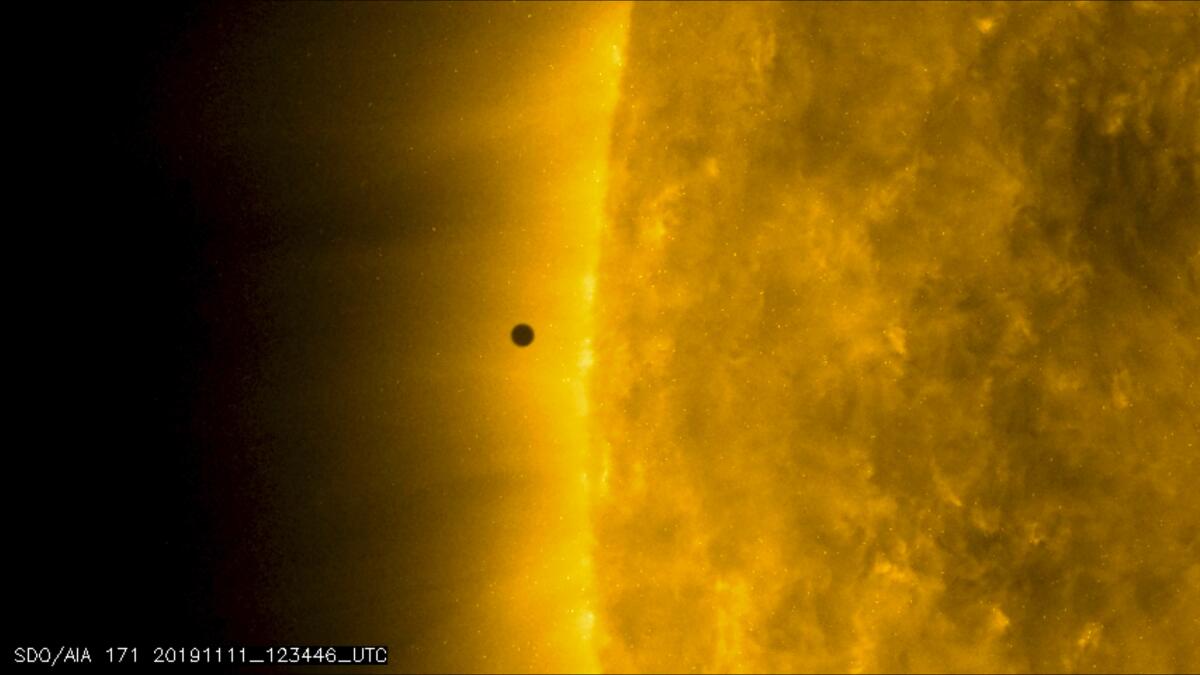
Mercury skips across sun’s vast glare in rare transit – Los …
Mercury may be small and elusive (it’s hard to spot from Earth due to its proximity to the Sun), but it’s full of mysteries—from its oversized core and potential diamond layers deep underground to why it defies standard planet-formation models. As BepiColombo prepares to unlock more secrets, this swift world continues to surprise astronomers.

DWARFLAB Dwarf 3 Smart Telescope - Portable, Capture Astronomy/Wildlife/Panorama, EQ Mode, Cloud Processing, 4K Auto-Tracking, Ultra-Light 3lb, Suits All Ages
$549.00 (as of March 1, 2026 06:05 GMT +00:00 - More infoProduct prices and availability are accurate as of the date/time indicated and are subject to change. Any price and availability information displayed on [relevant Amazon Site(s), as applicable] at the time of purchase will apply to the purchase of this product.)
Dianfan Telescope for Kids & Adults, 80mm Aperture 500mm Astronomical Professional Telescope for Adults High Powered, Portable Travel Telescopes for Beginners with Tripod & Adapter, Stickers, Backpack
$79.99 (as of March 1, 2026 06:05 GMT +00:00 - More infoProduct prices and availability are accurate as of the date/time indicated and are subject to change. Any price and availability information displayed on [relevant Amazon Site(s), as applicable] at the time of purchase will apply to the purchase of this product.)
MEEZAA Telescope, Telescope for Adults High Powered Professional, 90mm Aperture 800mm Refractor Telescopes for Astronomy Beginners Fully Multi-Coated with AZ Mount Tripod & Phone Adapter & Carry Bag
$169.99 (as of March 1, 2026 06:05 GMT +00:00 - More infoProduct prices and availability are accurate as of the date/time indicated and are subject to change. Any price and availability information displayed on [relevant Amazon Site(s), as applicable] at the time of purchase will apply to the purchase of this product.)
Celestron Travel Scope 70 Portable Refractor Telescope – 70mm Aperture, Fully-Coated Glass Optics – Includes Tripod, Backpack & Software – Ideal for Beginners & Travel
$99.99 (as of March 1, 2026 06:05 GMT +00:00 - More infoProduct prices and availability are accurate as of the date/time indicated and are subject to change. Any price and availability information displayed on [relevant Amazon Site(s), as applicable] at the time of purchase will apply to the purchase of this product.)
Telescope,Telescope for Adults High Powered, 90mm Aperture 900mm Professional Refractor Telescopes for Kids & Beginners, Magnification 450X,for Planet Observation with Stainless Tripod & Phone Adapter
$169.89 (as of March 1, 2026 06:05 GMT +00:00 - More infoProduct prices and availability are accurate as of the date/time indicated and are subject to change. Any price and availability information displayed on [relevant Amazon Site(s), as applicable] at the time of purchase will apply to the purchase of this product.)
Telescope, 70mm Aperture 400mm AZ Mount Astronomical Refracting Telescopes (20x-200x) for Kids & Adults, Portable Travel with Tripod Phone Adapter, Remote Control, Easy to Use, Black
$59.99 (as of March 1, 2026 06:05 GMT +00:00 - More infoProduct prices and availability are accurate as of the date/time indicated and are subject to change. Any price and availability information displayed on [relevant Amazon Site(s), as applicable] at the time of purchase will apply to the purchase of this product.)
Telescope 150EQ Astronomical Professional Telescope for Adults High Powered, Manual Equatorial Reflector Telescopes for Beginners with Phone Adapter, Moon Filter, Stainless Tripod - with Carrying Bag
$287.99 (as of March 1, 2026 06:05 GMT +00:00 - More infoProduct prices and availability are accurate as of the date/time indicated and are subject to change. Any price and availability information displayed on [relevant Amazon Site(s), as applicable] at the time of purchase will apply to the purchase of this product.)
Celestron StarSense Explorer DX 130AZ App-Enabled Telescope – 130mm Newtonian Reflector with Smartphone Dock & StarSense App – iPhone & Android Compatible – Easy-to-Use for Beginners
$428.99 (as of March 1, 2026 06:05 GMT +00:00 - More infoProduct prices and availability are accurate as of the date/time indicated and are subject to change. Any price and availability information displayed on [relevant Amazon Site(s), as applicable] at the time of purchase will apply to the purchase of this product.)
MEEZAA Telescope, 150EQ Newtonian Reflector Telescope for Adults Astronomy Beginners, Professional Astronomical Telescopes with Equatorial Mount, Phone Adapter, Tripod, Moon Filter and Large Carry Bag
$299.97 (as of March 1, 2026 06:05 GMT +00:00 - More infoProduct prices and availability are accurate as of the date/time indicated and are subject to change. Any price and availability information displayed on [relevant Amazon Site(s), as applicable] at the time of purchase will apply to the purchase of this product.)